Seawater is challenging

Seawater is almost always challenging to handle in process plants due to fouling that accumulates on surfaces, corrosion, and foreign objects in the water. These foreign objects typically include everything from fish, shrimp, mussel larvae, plastic bags, pieces of wood, seaweed, and grass - materials that must be removed with varying degrees of care before the water enters the process system.

At DIN Forsyning in Esbjerg, they send a cleaning pig through the pipeline.

Watch the video and follow the pig through the pipe!

Date

Mar. 17. 2026

Author

Torkild Christensen

In the Wadden Sea south of Esbjerg - one of Denmark’s Natura 2000 areas - biological activity is exceptionally high, providing a rich feeding ground for thousands of birds.
The high biological activity creates extraordinary challenges when designing seawater systems. 

“Design” here does not refer to aesthetics, but to ensuring that a process plant is engineered to handle all the foreign materials, mussel and barnacle larvae, and other organisms that inevitably enter with seawater.

And since Murphy’s Law also applies in Esbjerg, these factors can set the stage for operational challenges throughout a plant’s 30‑year lifetime unless it is carefully designed with a strong focus on fouling resistance.

The many types of fouling

  • Fouling from mussels, barnacles, etc.

    Mussels, barnacles, and similar organisms attach themselves everywhere in process plants. Boat owners know barnacles well—they increase friction on boat hulls, slowing the vessel down and raising fuel consumption. In process systems, these organisms attach to pipes, valves, pumps, heat exchangers—anywhere conditions are “comfortable” for them due to the steady flow of food-rich seawater. Mussel and barnacle larvae number in the billions and are far smaller than 1 mm. This means that “normal” filters offer no protection. And if the mesh is fine enough to stop them, the filter quickly clogs with other particles, causing a significant pressure drop.

  • Fouling from microorganisms

    Bacteria, fungi, and microbial communities form a slimy layer on the inner surfaces of pipes. This makes it even easier for the above-mentioned larvae to settle, while also creating a foundation for microbially induced corrosion (MIC)—a highly aggressive type of bio-chemical corrosion that can affect even seawater-resistant metals.

Here, we focus on combating shellfish such as mussels and barnacles. Microbially induced corrosion is a topic for another day.
The Fisheries and Maritime Museum counts mussel and barnacle larvae

During the first phase of the “Fremtidens Fjernvarme” (The future district heating) project at DIN Forsyning, biologists from the Fisheries and Maritime Museum in Esbjerg systematically examined which months of the year present the highest challenges with larvae. This gave us a clear picture of when to expect extra maintenance work, including filter cleaning to avoid blockages.

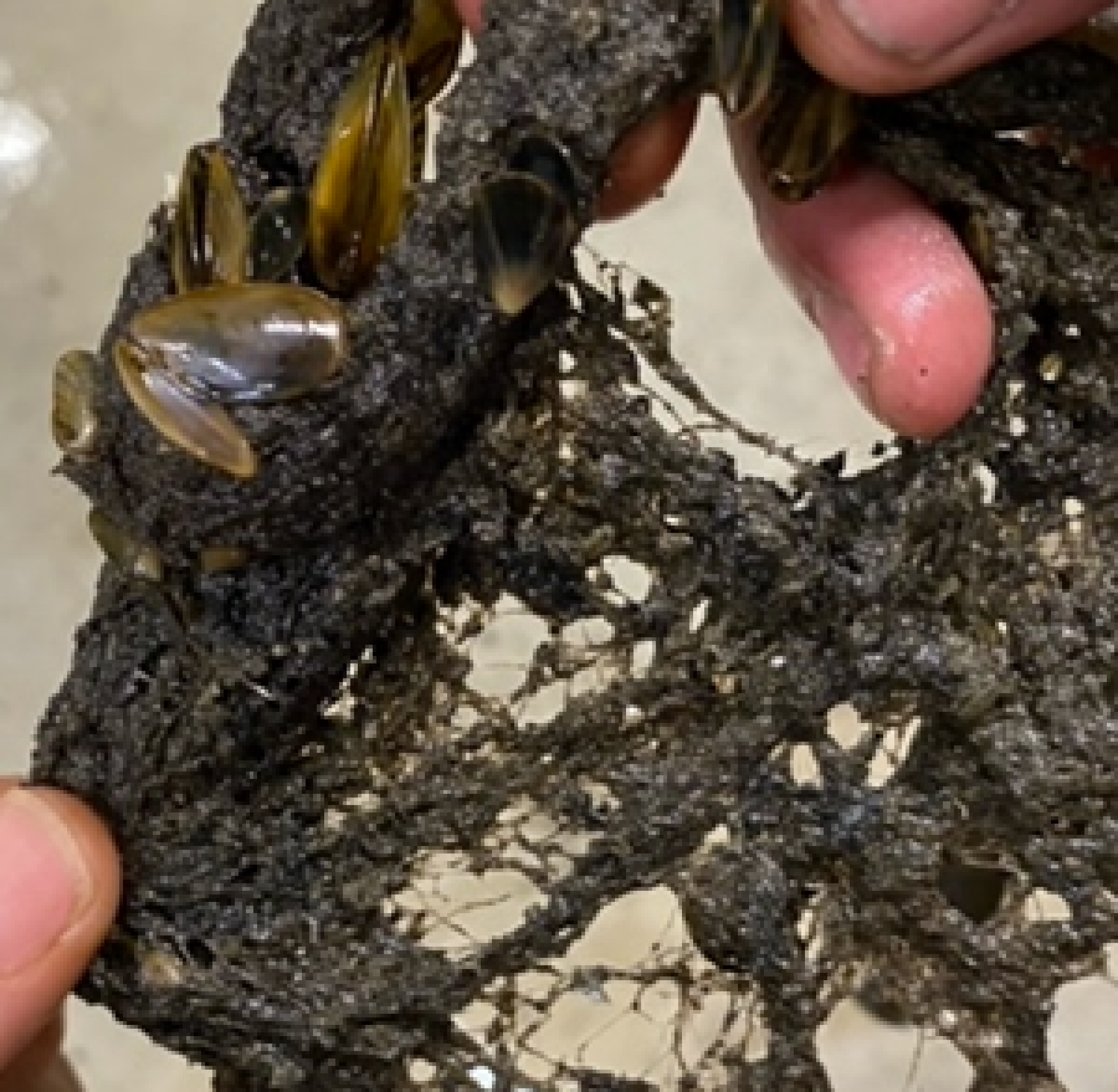
A particular challenge is the mussels’ byssus threads—or “fairy hairs,” as we often call them. Even the best filters struggle when large amounts of these threads must be removed from the filter surface.

Unfortunately, the Museum’s larval counts showed that the growth period for mussels and barnacles extends over most of the year. Therefore, the best solution is to clean the piping systems frequently year-round, though at somewhat longer intervals during winter.

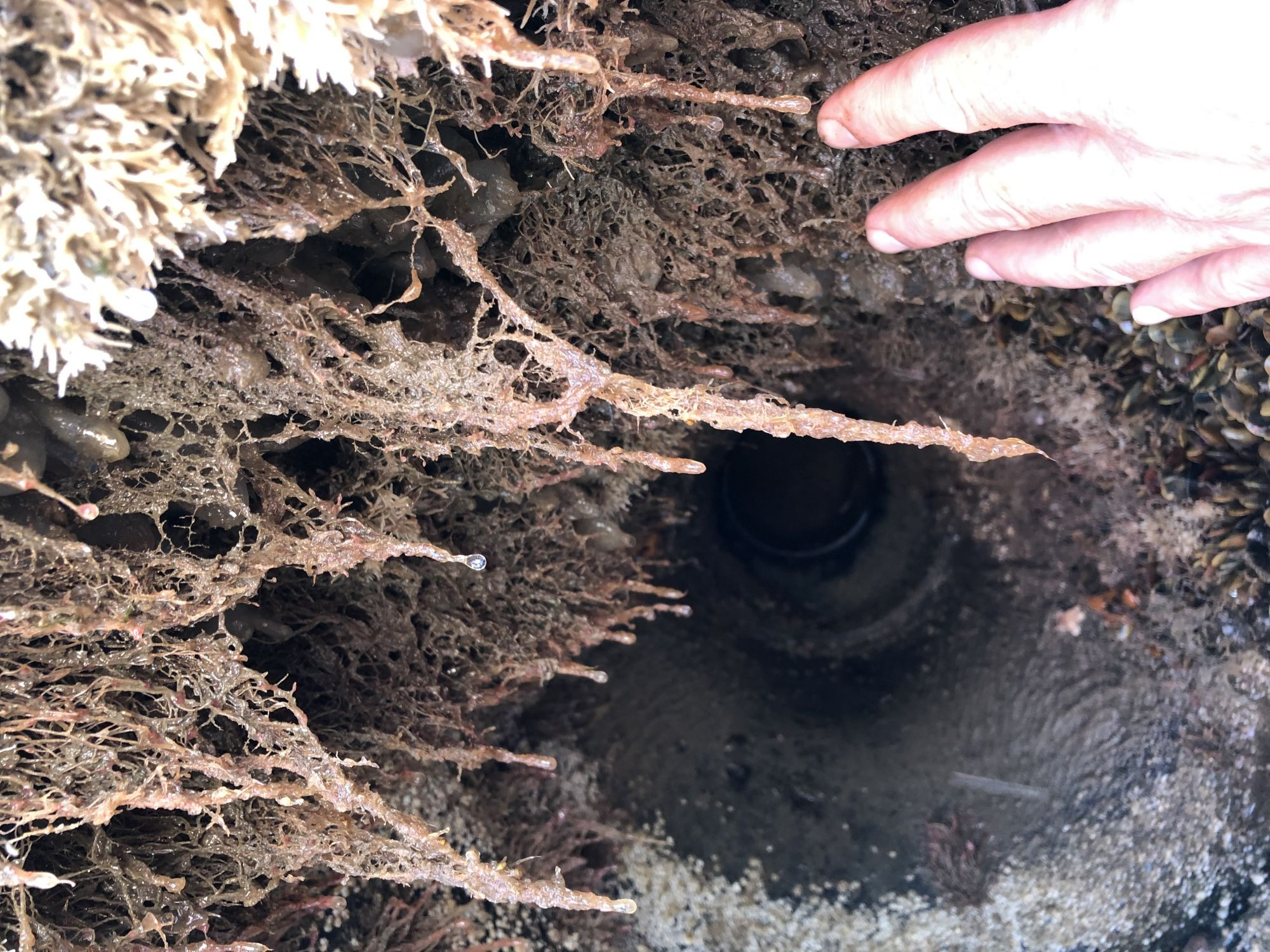
If cleaning is neglected, mussels grow large and form long byssus threads that clog virtually everything—similar to hair in a shower drain, but in far greater quantities. Barnacles form hard shells that increase friction inside pipes, which leads to higher pumping energy consumption.

Photo caption: Images show a clean mussel filter and how it becomes clogged if mussels are allowed to grow large, causing longer, more entangled byssus threads.

The below photo llustrates severe problems caused by mussels, algae, and other fouling in pipes. 

When chemical treatment is prohibited, you use a pig

In Denmark, chemical fouling control is largely prohibited. This rules out, for example, chlorine, which would otherwise be highly effective.

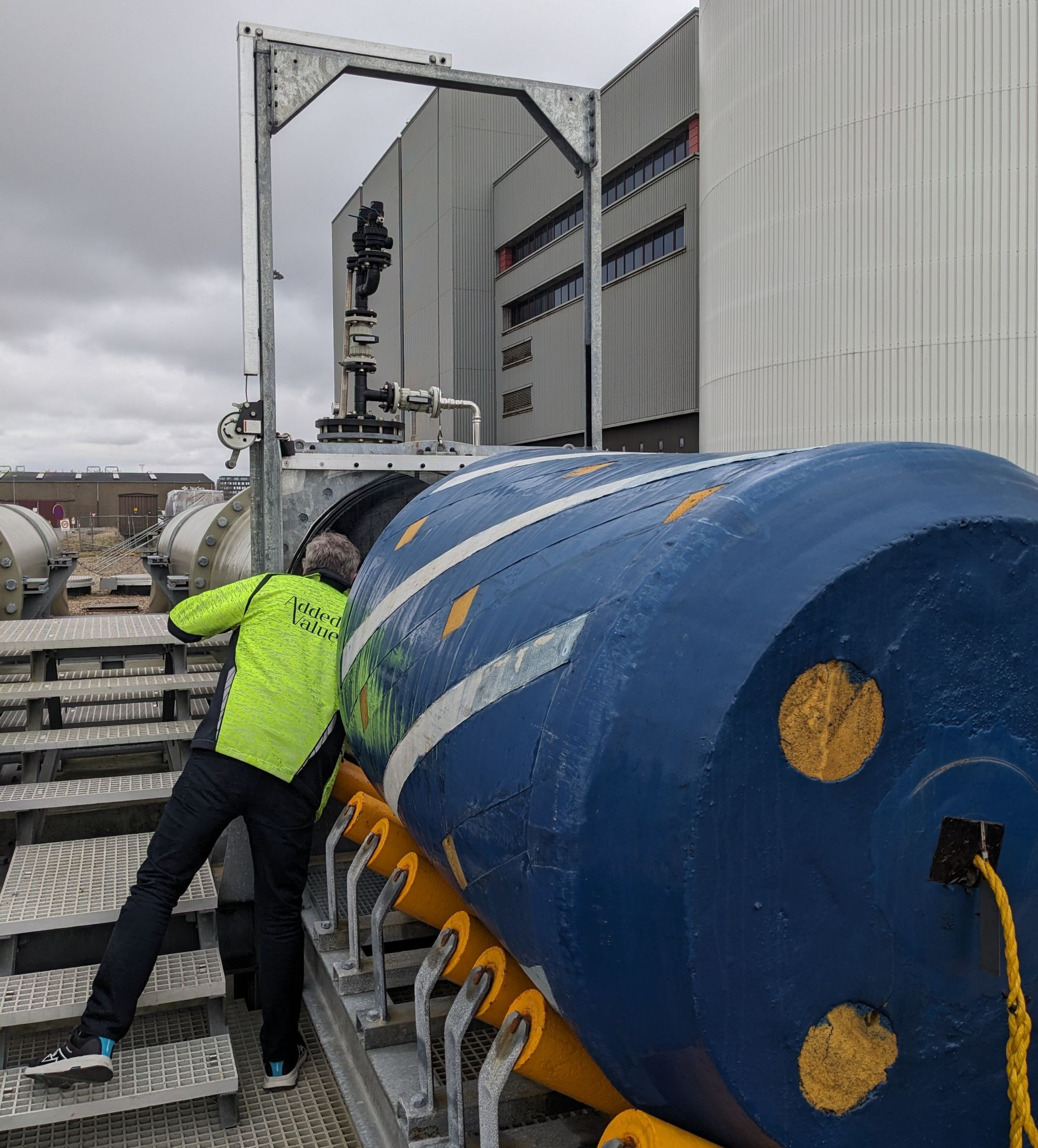
Instead, we must rely on mechanical cleaning methods and sound engineering: intelligent pipeline design, the correct corrosion‑resistant alloys, and a wide range of mechanical cleaning techniques. One such technique is sending a cleaning pig through the pipeline at regular intervals. The pig scrapes deposits from the pipe wall before mussels, barnacles, or other organisms can grow to a level that affects system performance.

The below photo shows Added Values' specialist Torkild Christensten inspecting a "cleaning pig". 

Watch the pig rush through the pipe

DIN Forsyning in Esbjerg has mounted a video camera on the pig’s—shall we say—snout, to observe the condition of the pipe and how the pig moves forward. The pipe is nearly new, so its interior is in excellent condition.

The pipeline is about 1.2 meters in diameter. The pig is launched from one end via a “pig launcher,” propelled by seawater pumped at high flow. It travels through the pipe at roughly 3–4 km/h (about 1 m/s) and reaches the outlet (the “pig receiver”) after around 15 minutes.

By clicking the below link, you can join the pig on a journey through the 1,500‑meter pipeline supplying DIN Forsyning’s 70 MW heat pump. 

Click and enjoy the ride through the pipe!

We apologize that the text is only in Danish, but the images should speak for themselves


Fact Box:
Fouling is the technical term for deposits such as slime, mussels, barnacles, and other contaminants that accumulate on surfaces.